
Custom Ferrite Rod Transformer Manufacturing
Custom Ferrite Rod Antenna Manufacturer
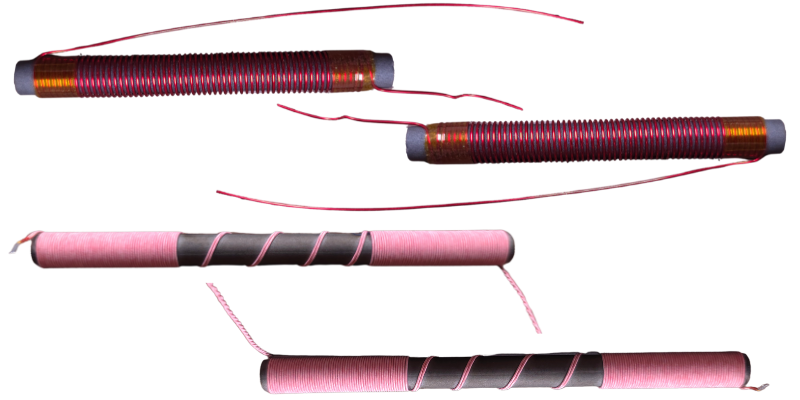
Leightner has worked a number of companies for various applications utilizing custom ferrite rod transformer antennas. Some of our current clients applications are using our ferrite rod antennas in ground penetrating radar and well as certain avionics for military fighter jets.
To suit your unique application requirements, Leightner Electronics designs custom ferrite rod transformers to your specifications. All of our unique ferrite rod transformers are engineered and manufactured in-house at our facility in McKinney, Texas, where we also maintain full control over all engineering, prototyping, design and development. To find out how Leightner may help your transformer needs, call 972-542-0176 or contact us!
What is a Ferrite Rod Transformer Antenna?
A ferrite rod antenna, also known as a ferrite bar aerial or loopstick antenna, is a compact magnetic loop antenna commonly used in AM broadcast radios for medium and long waveband reception, as well as in RFID and other wireless applications. The antenna consists of a rod or bar made from ferrite—a magnetic material with high permeability—around which a coil of wire is wound. This coil is typically connected to a variable tuning capacitor within the radio circuitry, allowing the antenna to be tuned to resonance at desired frequencies.
The ferrite rod serves to concentrate the magnetic component of incoming radio waves, greatly increasing the antenna’s sensitivity compared to a similarly-sized air-core coi. This design enables effective reception of lower-frequency signals (typically from 50 Hz up to a few MHz), making it ideal for portable and compact devices.
Ferrite Rod Construction and Basic Operation
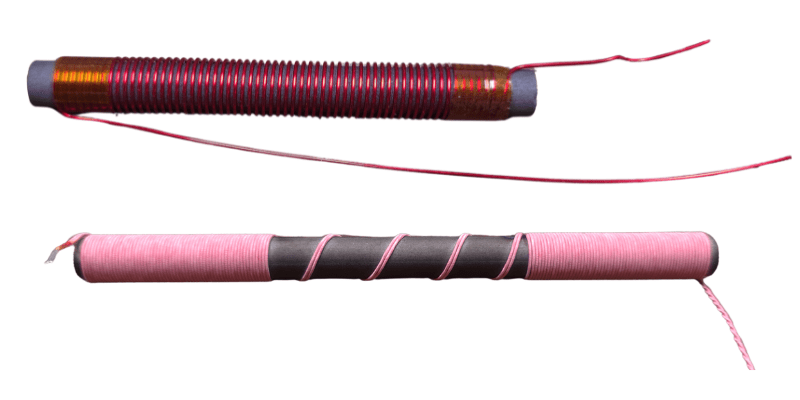
A ferrite rod antenna consists of a cylindrical ferrite core with one or more coils of wire wound around it. The ferrite material—a high‐permeability iron‐based ceramic—concentrates the magnetic field of incoming radio waves into the coil, effectively increasing the loop’s effective area and boosting signal strength over an air‐core loop of comparable size.
When the coil is tuned into resonance with a variable capacitor in the receiver, the circuit forms an LC resonator that selects the desired frequency. Because it couples to the magnetic component of electromagnetic waves, the antenna is directional: it receives maximum signal when the rod is perpendicular to the transmitter and exhibits deep nulls when aligned with it.
Performance Characteristics
- Frequency Range: Primarily effective on longwave and mediumwave bands (≈150 kHz–3 MHz), with limited use into the lower shortwave band. Performance degrades at higher frequencies due to increased ferrite losses.
- Efficiency: Lower than full‐size external antennas; typically used solely for reception. Transmitting applications are limited to very low power levels to avoid core heating.
- Quality Factor (Q): High-Q circuits (Q≈1000 at a few hundred kilohertz) are achievable using medium‐permeability ferrites, yielding narrow bandwidth and requiring precise tuning.
- Radiation Resistance: Without ferrite, a small loop has very low radiation resistance, causing high wire losses. The ferrite core increases radiation resistance by a factor of μ^2, reducing resistive losses in the winding.
Ferrite Rod Antenna Design Considerations
- Core Material: Selection of ferrite composition (NiZn vs. MnZn) and permeability depends on the target frequency and desired Q.
- Rod Dimensions and Coil Turns: A balance between rod length/diameter, number of turns, and wire gauge determines inductance, resonant frequency, and size. A shorter, wider coil with more turns can match voltage output of a longer, thinner coil with fewer turns, offering flexibility in physical design.
- Tuning Mechanism: In broadcast radios, the tuning capacitor is often ganged with the receiver’s RF stage for simultaneous antenna and circuit tuning, minimizing components and cost.
Applications for Ferrite Rod Transformers
Ferrite rod antennas are widely used in various applications due to their compact size, high sensitivity for magnetic fields, and ability to fit into small devices.
Let Leightner Design Your Ferrite Rod Antenna Today
With over 50 years of manufacturing and hundreds of thousands of ferrite transformers built to specifications, Leightner can handle any application of your custom Ferrite transformer needs. Request a quote to start the manufacturing process today!
Contact Us Today For Your Custom Transformer Needs
Leightner has over 50 Years of Experience Prototyping, Designing, & Manufacturing Custom Transformers For All Types of Applications